

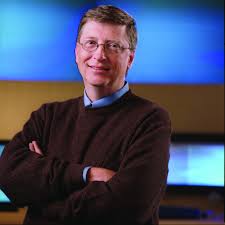
 William Henry
 "
Bill"
Gates III (born October 28, 1955)
[3] is an American
business magnate,
philanthropist, author, and is
chairman of
Microsoft, the software company he founded with
Paul Allen. He is consistently ranked among the
world's wealthiest people[4] and was the wealthiest overall from 1995 to 2009, excluding 2008, when he was ranked third.
[5] During his career at Microsoft, Gates held the positions of
CEO and
chief software architect, and remains the largest individual shareholder, with more than 8 percent of the
common stock.
[6] He has also authored or co-authored several books.
Gates is one of the best-known entrepreneurs of the personal computer revolution. Although he is admired by many, a number of industry insiders
criticize his business tactics, which they consider anti-competitive, an opinion which has in some cases been upheld by the courts.
[7][8] In the later stages of his career, Gates has pursued a number of philanthropic endeavors, donating large amounts of money to various charitable organizations and scientific research programs through the
Bill & Melinda Gates Foundation, established in 2000.
Gates stepped down as chief executive officer of Microsoft in January 2000. He remained as chairman and created the position of chief software architect. In June 2006, Gates announced that he would be transitioning from full-time work at Microsoft to part-time work, and full-time work at the Bill & Melinda Gates Foundation. He gradually transferred his duties to
Ray Ozzie, chief software architect, and
Craig Mundie, chief research and strategy officer. Gates' last full-time day at Microsoft was June 27, 2008. He remains at Microsoft as non-executive chairman
Early Life
Gates was born in
Seattle, Washington, to
William H. Gates, Sr. and
Mary Maxwell Gates, of
English,
German, and Scotch-Irish descent.
[9][10] His family was upper middle class; his father was a prominent lawyer, his mother served on the board of directors for
First Interstate BancSystem and the
United Way, and her father, J. W. Maxwell, was a
national bank president. Gates has one elder sister, Kristi (Kristianne), and one younger sister, Libby. He was the fourth of his name in his family, but was known as William Gates III or "
Trey" because his father had dropped his own "III" suffix.
[11] Early on in his life, Gates' parents had a law career in mind for him.
[12] When Gates was young, his family regularly attended a
Congregational church.
[13][14][15]
At 13 he enrolled in the
Lakeside School, an exclusive preparatory school.
[16] When he was in the eighth grade, the Mothers Club at the school used proceeds from Lakeside School's
rummage sale to buy an
ASR-33 Teletype terminal and a block of computer time on a
General Electric (GE) computer for the school's students.
[17] Gates took an interest in programming the GE system in
BASIC, and was excused from math classes to pursue his interest. He wrote his first computer program on this machine: an implementation of
tic-tac-toe that allowed users to play games against the computer. Gates was fascinated by the machine and how it would always execute software code perfectly. When he reflected back on that moment, he said, "There was just something neat about the machine."
[18] After the Mothers Club donation was exhausted, he and other students sought time on systems including
DEC PDP minicomputers. One of these systems was a
PDP-10 belonging to Computer Center Corporation (CCC), which banned four Lakeside students—Gates,
Paul Allen,
Ric Weiland, and Kent Evans—for the summer after it caught them exploiting bugs in the
operating system to obtain free computer time.
[19]
At the end of the ban, the four students offered to find bugs in CCC's software in exchange for computer time. Rather than use the system via teletype, Gates went to CCC's offices and studied
source code for various programs that ran on the system, including programs in
FORTRAN,
LISP, and
machine language. The arrangement with CCC continued until 1970, when the company went out of business. The following year, Information Sciences, Inc. hired the four Lakeside students to write a payroll program in
COBOL, providing them computer time and royalties. After his administrators became aware of his programming abilities, Gates wrote the school's computer program to schedule students in classes. He modified the code so that he was placed in classes with mostly female students. He later stated that "it was hard to tear myself away from a machine at which I could so unambiguously demonstrate success."
[18] At age 17, Gates formed a venture with Allen, called
Traf-O-Data, to make
traffic counters based on the
Intel 8008 processor.
[20] In early 1973, Bill Gates served as a congressional page in the U.S. House of Representatives.
[21]
Gates graduated from Lakeside School in 1973. He scored 1590 out of 1600 on the
SAT[22] and enrolled at
Harvard College in the autumn of 1973.
[23] While at Harvard, he met
Steve Ballmer, who later succeeded Gates as CEO of Microsoft.
In his sophomore year, Gates devised an algorithm for
pancake sorting as a solution to one of a series of unsolved problems
[24] presented in a
combinatorics class by
Harry Lewis, one of his professors. Gates' solution held the record as the fastest version for over thirty years;
[24][25] its successor is faster by only one percent.
[24] His solution was later formalized in a published paper in collaboration with Harvard computer scientist
Christos Papadimitriou.
[26]
Gates did not have a definite study plan while a student at Harvard
[27] and spent a lot of time using the school's computers. He remained in contact with Paul Allen, joining him at Honeywell during the summer of 1974.
[28] The following year saw the release of the
MITS Altair 8800 based on the
Intel 8080 CPU, and Gates and Allen saw this as the opportunity to start their own computer software company.
[29] He had talked this decision over with his parents, who were supportive of him after seeing how much Gates wanted to start a company.
[27]


